




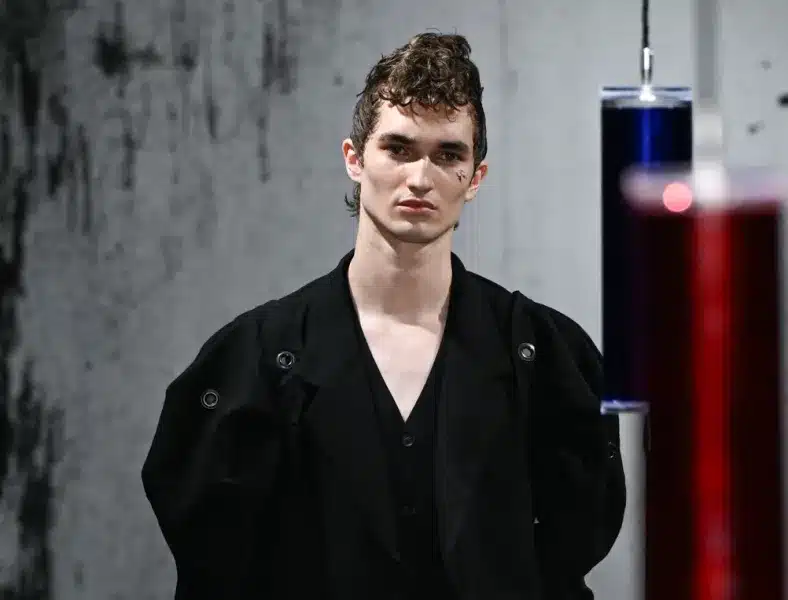
“Make haste slowly; do not be discouraged, but return to the work frequently,” suggested the 17th-century French critic and poet Nicolas Boileau. This ethos of patient, iterative refinement was palpable in Yohji Yamamoto’s latest Spring menswear presentation. This season, Yamamoto dedicated himself to an exhaustive study of the shoulder, approaching the garment’s construction with the meticulousness of a Renaissance artist preparing a series of anatomical sketches for a grand masterwork.
Experimental Tailoring and Proportional Shifts
The collection began with a sequence of three monochromatic black ensembles that served as a blueprint for the season. These opening looks featured elongated jackets characterized by complex pleated sleeves attached via prominent grommets, styled over fluid shirts and wide-leg shorts. Upon closer inspection, what seemed like a uniform aesthetic revealed a series of sophisticated experiments in construction. Yamamoto manipulated the silhouette by introducing peaked shoulders, cocoon-like volumes created through fabric inserts, and even the complete removal of sleeves, demonstrating a masterful command over architectural proportions.
Historical Chivalry as a Modern Protective Layer
Drawing on his extensive knowledge of costume history, Yamamoto appeared to bridge the gap between 19th-century sartorial traditions and modern-day needs. This period often reinterpreted the concepts of chivalry and medieval armor through specific motifs and volumes. In this collection, that influence manifested as a form of “modern armor.” Heraldic symbols, including animal imagery and crosses, decorated the garments, while a diverse palette of materials—ranging from raw unbleached linen and signature black wool to intricate lace and devoré velvet—recalled the regalia of past centuries. Metallic-finished knits and vibrant red accents further evoked the texture of chain mail, offering a sense of protection in an unpredictable world.
Poetic Narratives and Gender-Fluid Casting
The collection also featured a reflective, almost cryptic layer of storytelling. Several garments were emblazoned with poetic text on the back, touching on themes of nostalgia, “inner ghosts,” and the search for a sense of elsewhere. These messages hinted that the true challenges of modern life are often internal rather than external. This narrative was reinforced by a cast that prioritized character and lived-in presence over traditional modeling standards. Breaking away from rigid gender norms, jewelry designer Rie Harui—creative director of the Yohji Yamamoto by Riefe line—closed the show. Yamamoto emphasized her significance to the brand, noting that her presence as both a woman and a fellow designer was a vital component of the collection’s identity.
Final Thoughts: Resilience Amidst a Changing Climate
When reflecting on the current global state and the intense heat surrounding the fashion season, Yamamoto offered a philosophical perspective on the dichotomy of modern existence. He described the present atmosphere as being simultaneously comfortable and uncomfortable, acknowledging the difficulties of the current era. Ultimately, his work serves as a testament to persistence; despite the weight of the world, his message is clear: the craft must continue, and one must find the strength to keep moving forward. Through this collection, Yamamoto proves that clothing is not just about aesthetic form, but a vital means of navigating the complexities of the human condition.