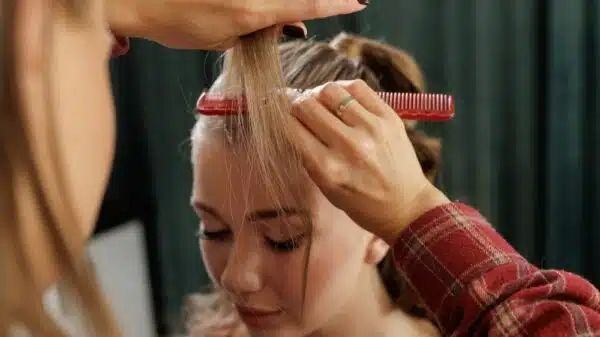













The woman in the salon chair cannot see what the makeup artist sees.
She watches the mirror, tracking the transformation. What she cannot observe is whether the foundation was sheered properly at the jawline. Whether the eyeshadow transition holds a gradient or just kind of suggests one. Whether the lip line will survive a glass of champagne.
She sees the result. The artist, if the artist knows what she’s doing, sees every decision that got there.
The beauty industry has been dealing with this gap for years: what does “professional” even mean when anyone with a ring light and a YouTube tutorial can get results that photograph well?
Tetiana Zaruba has to answer this question practically, not theoretically. As an international makeup judge certified through the International Beauty Judging Academy, she evaluates competitive work where the difference between professional and amateur has to be measurable. Vague impressions don’t work. There has to be a standard.
The Noise Problem
Social media did something strange to the industry. Tutorials, product reviews, visual inspiration – there’s more access than ever. But somehow that made it harder, not easier, for clients to tell real expertise from confident presentation.
Heavy contouring, dramatic transformations – that stuff gets engagement. Clean technique doesn’t really go viral.
Zaruba calls it visual noise.
“Scroll through any platform,” she says. “Thousands of faces that look striking in photographs. But photography hides everything. Whether the blend is smooth or just blurred in post. Whether the base will oxidize in two hours. You can’t see any of that.”
The distinction matters because professional makeup isn’t defined by how it looks in a single image. It’s defined by how it performs – over time, under different lighting, through the conditions of an actual day. And that’s exactly what competition judging is designed to measure.
What Judges Actually See
Zaruba got her IBJA certification in 2023 – theoretical coursework, practical training, evaluation ethics. The program standardizes how judges across different countries assess the same work, creating shared criteria for what “correct” execution means.
What they look for isn’t what most people expect. Symmetry from multiple angles. Blending quality up close. How clean the work is around the waterline, the lip border. Whether the makeup matches the competition category.
You can enter a theatrical look in bridal and it doesn’t matter how beautiful it is – wrong category. You can enter something creative with technical flaws and it doesn’t matter how original it is – the flaws count.
“The audience sees drama,” she says. “I’m looking at decisions. Every brush stroke, every product choice – those are decisions. I’m basically reading them backward, trying to figure out what the artist did and whether they did it right.”
This is where her background shapes her perspective. Over five years in the industry, Zaruba has worked both sides – competing and judging.She’s won awards in makeup artistry and beauty training categories and earned a nomination to the International Beauty Awards before crossing over to evaluation.
That sequence matters. She learned what judges look for by being judged first.
“Competitions taught me to see my own work honestly,” she says. “When you’re standing in front of judges who are going to find every flaw, you learn to find those flaws first. And that carries over – client work, teaching, all of it.”
Beyond the Surface
Her time at international conferences and congresses on aesthetics and beauty medicine added another layer. Skin isn’t a canvas you cover up. It reacts, it changes through the day. Professional technique means working with that, not against it.
So when Zaruba evaluates, she’s thinking about durability. How makeup reacts to real conditions. What happens over time. Her feedback style reflects this – specific and structured. Not “I didn’t like the colors” but “the transition between crease and brow bone shows visible demarcation at the outer third.”
“If the feedback is specific, they can actually fix it,” she says. “Vague feedback doesn’t help anyone.”
This approach connects to a larger problem in the industry: the gap between technical skill and commercial success. Artists with amazing technique sometimes can’t build a sustainable practice. Meanwhile, people with less skill do fine commercially. The market doesn’t automatically reward craft.
The Business Reality
Zaruba noticed this pattern through years of judging and teaching. At her Beauty Studio and Training Center, she developed a framework to address it – Beauty and Business Balance, ten steps she’s presented at international beauty summits and educational forums.
“Being good at makeup doesn’t mean you’ll make money doing it,” she says. “You can be the most skilled artist in your city and still struggle because you don’t know how to communicate value, how to price, how to build something sustainable.”
Her academic work approaches the same problem with data. A 2025 study examined how online booking platforms change the economics of makeup services – client acquisition costs, scheduling efficiency, how digital presence affects pricing power. Understanding why a market behaves is different from just navigating it by instinct.
The industry is splitting. People who learned from tutorials and work cheap. And trained professionals who charge more because the work is actually different.
“Clients are starting to figure this out,” Zaruba says. “They come to me after bad experiences elsewhere. Same story every time: it looked fine in the salon, then it didn’t last.”
What Clients Actually Pay For
Most people can’t explain what makes good makeup different from great makeup. They know it when they experience it – foundation oxidizing by noon, eyeshadow creasing, lip color bleeding past the line. But they don’t have vocabulary to evaluate an artist before they book.
Competition criteria work as a useful proxy. Durability. Precision. Whether the makeup fits the context. Whether the technique holds up in real conditions.
“A bride isn’t paying for makeup,” Zaruba says. “She’s paying for makeup that lasts twelve hours, photographs well, looks right for her face. Those are judging categories. There’s a reason for that.”
For anyone trying to find a real professional in a crowded market, her advice is practical: watch how they work. How they hold their tools, how they approach the face, whether they check from different angles. The craft is visible before the makeup is done.
Visual noise isn’t going away. Someone posts a before-and-after, gets ten thousand likes. But likes don’t measure whether that makeup holds up at a wedding, under flash photography, through an eight-hour day.
For artists who want to meet real professional standards, Zaruba has one suggestion: get evaluated. Enter competitions. Ask for feedback from judges trained to assess technique.
“You think you’re good until someone with a checklist tells you you’re not,” she says. “That’s what competition does. That’s what judging does.”